

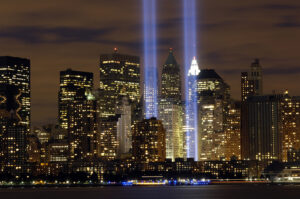
“Tribute in Light (Air Force 2)”, U.S. Air Force / Denise Gould photo, September 11, 2006.
Remembrances on 9/11 for the 25th Anniversary
by Alex Deselms, Executive Director/Director of Collections
It seems particularly poignant, in this climate of political violence and extreme disagreement, that the 25th anniversary of the terrorist attacks on the World Trade Center and the Pentagon on Sept 11th, 2001, falls on the 250th anniversary year of the United States. While a large step forward in republicanism and democracy, the American Revolution was, after all, rather violent (check out PBS and Ken Burns’ six-episode series for details). Americans came together in 2001 like we imagine Americans did in 1776, though in truth, there were also a lot of loyalists and those who didn’t want to pick a side in the American Revolution.
I was too young to remember (or pay attention to) the Oklahoma City Bombings in 1995. I vaguely remember hearing about the Columbine School shooting in the news in 1999 (I was in 2nd grade). 9/11 was the defining moment of my childhood. Indeed, 9/11 became the defining moment of my millennial generation just as Pearl Harbor was for those who became the Greatest Generation.
On that morning in 5th grade, I was downstairs eating breakfast with Dad while Mom was upstairs, finishing getting ready for the day. Mom called down that the news was showing an airplane crash. We came up to watch, spellbound. It was mesmerizing, but we didn’t understand as we watched that morning that the plane crash was intentional. At school, as we waited in the halls to switch rooms (5th graders at my elementary school switched classes to prepare us for middle school), teachers and students gossiped and discussed the news–it was so crazy, we had to talk about it even if what happened wasn’t fully understood at first. It seems like after school, the news came out that it was a terrorist attack directed by Osama bin Laden and Al-Qaeda in Afghanistan.
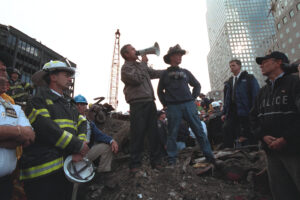
“Standing Atop Rubble with Retired New York City Firefighter Bob Beckwith, President George W. Bush Addresses Approximately 400 Police, Firemen and Rescue Workers by Bullhorn at the Site of the Collapsed World Trade Center in New York City,” White House Photo Office (George W. Bush Administration), National Archives 213246384, September 14, 2001.
It was heartbreaking…but heartening in the way all America, and in a way the world, came together. Looking back, the feeling of coming together] seems like something that hadn’t happened since Pearl Harbor (and hasn’t since 2001). I remember watching Muslim American students on morning and evening news shows, reminding us that it was extremist Muslims who attacked the U.S., not the Islamic religion.
I vaguely remember knowing the airports shut down. I don’t remember the other shutdowns. I don’t remember the details, but I know it happened. I’m not sure exactly what’s memory and what’s been imbued by learning after the fact.
I can still remember and visualize the images and videos of the Twin Towers being hit by the planes. I can still see the photograph of the 9/11 first responders raising the American flag on the site of the World Trade Center, as iconic as the statue and photos of the Marines raising the American flag on Iwo Jima.
9/11 was a changing point. Stories came out about the Taliban and how they treated their own Afghan people, especially the women. It was either 7th or 8th grade when I read The Breadwinner, a novel about a girl in Afghanistan under the Taliban. She had to pretend to be a boy so she could go out and earn money to feed her family since her father had been arrested and her mother couldn’t go out without a male escort; the family eventually escaped to a refugee camp. It reiterated to me the destruction caused by the Taliban and other fundamentalist groups (of all races and religions), especially towards women. Women are not “inferior,” no matter how fundamentalists try to claim that. We deserve respect and rights.
On the 1-year anniversary of 9/11, our middle school held a memorial in a small garden that had been designated as a memorial garden. The Spanish teacher’s son had died in the military’s invasion of Afghanistan. At the memorial, Mrs. Romero was crying, reminding us of the sacrifices Americans had made to secure our people. Our middle school had a Veterans Day program every year on November 11, organized by a student group with a teacher’s oversight; I helped all three years, and we started showing a slideshow of town veterans. Mrs. Romero’s son was pictured…and she always cried. 9/11 remained vividly in our memory. The War on Terror, and the related first anniversary of 9/11, had a whole page in the news section at the end of my first middle school yearbook.
I don’t remember doing a lot of other anniversaries for 9/11, with maybe an exception for the fifth anniversary. Too many other emergencies had come up and taken attention away from the anniversary: the war in Iraq; Hurricane Katrina; the War on Terror in general. Every year, it seemed to get farther away and less important in the nation’s memory, with less news coverage of the anniversaries.
There were a number of songs that came out after 9/11, written in relation to the tragedy, that were (and are) meaningful to me. Alan Jackson’s “Where Were You (When the World Stopped Turning)” is the major song I think of; but there was also “Where the Stars and Stripes and the Eagle Fly” by Aaron Tippin and (over the next two years) “Courtesy of the Red, White, and Blue” by Toby Keith and “Have You Forgotten?” by Darryl Worley. Even now, nearly 25 years later, these songs can take me right back to those feelings: sadness, pride, patriotism, and maybe a little anger. I frequently stay in the car to let those songs finish as I sing along (and tear up a little).
I’m a big crime drama fan. The TV show NCIS premiered after the second anniversary, in 2003. I don’t remember specifics about 9/1 in the early episodes, but the War on Terror was a major aspect of those cases. Later, season 16, episode 20, “Hail & Farewell,” focused on the aftermath of the Pentagon 9/11 attack. It was moving, because somehow the Pentagon and the Pennsylvania Field parts of 9/11 don’t stick in my mind as much (although they should, as they are just as momental). The TV show CSI: New York also featured the 9/11 attack aftermath, with the powerful first episode of Season 8 titled “Indelible;” although it premiered a couple weeks after the 10th anniversary date, the episode was centered on the 10th anniversary of the attack and characters’ remembrances. Because a character had transferred from DC, the Pentagon attacks are also discussed.
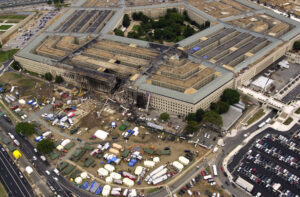
“An overall aerial view, two days later, of the impact point on the Pentagon where the hijacked American Airlines Flight 77, a Boeing 757-200 entered, breaking up in the process.” Combined Military Service Digital Photographic Files, between 1982–2007; National Archives 6523869, September 14, 2001.
The things I remember about the attack (shock, horror, coming together, reiterating that the actions of a few do not condemn the majority) also show up in the Cody and Powell newspapers. In the September 12th Cody Enterprise, there were quotes from 6 “people on the street.” All were shocked and horrified. It was an inescapable feeling for Americans and many people around the world. The Cody and Powell papers on September 12 and September 13, respectively, discussed the ways churches provided support and refuge for Wyomingites struggling to process the tragedy as well as the need and specifics for blood donation. Stories like this played out throughout the world.
An article in the Cody Enterprise on November 14, 2001, announces a talk on Islam on Sunday, November 18, at Christ Episcopal Church. Just like the students I remember on the news, the presenter was scheduled to talk about the relationship between Christianity and Islam (and Judaism) with a practicing Muslim from Riverton who worked at the college. The write-up article does not state how well attended the presentation was, but it discusses the tenets of Islam and the focus that the actions of a few fundamentalists are not condoned by the majority. The Islamophobia in the wake of the 9/11 attacks could have been pervasive; in fact, there were a couple of op-eds in the various September Cody Enterprise papers that were Islamophobic and anti-religious tolerance. But American Muslims and other advocates for religious tolerance (of all religious beliefs) managed to significantly calm the Islamophobic rhetoric, although they could not overcome it completely. In the Cody Enterprise, most op-eds did, in fact, remind readers to practice tolerance.
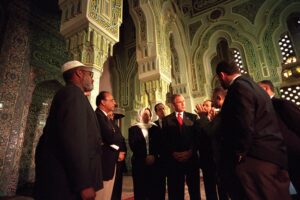
“President George W. Bush talks with community leaders after touring the Islamic Center of Washington, DC.” White House Photo Office (George W. Bush Administration), National Archives 5997318, September 17, 2001.
The Cody Enterprise reported on September 12th, 2001, that the Cody High School history classes spent the day discussing and dissecting the events. TVs in all classrooms were tuned to the news coverage throughout the day. The reporter, Juliette Rule, started the article with an impactful quote: “For many [students], it’s their first experience with a national tragedy, but unlike their grandparents, they watched the sinister events unfold live on television.” It’s a quote that certainly fits my experience of the events. Talking to my grandmother a few years ago about some of her memories, Nana told us she remembered hearing the news about Pearl Harbor on the car radio after they went for a Sunday afternoon drive–after the morning’s events; we watched the crashes and resulting chaos live.
Something emphasized in the Cody reporting that I don’t remember is the closing of sites like the Buffalo Bill Dam Visitor Center. In the wake of the 9/11 attacks, we remember that planes were grounded. But other infrastructure was also affected, with the fear that these sites would also be targeted. The visitor center at the Buffalo Bill Dam normally opens in May and closes in October. In 2001, it closed for the season after 9/11 due to the security concerns.
A Cody Enterprise op-ed in the September 17 issue reminds readers not to focus exclusively on rewatching and watching the news. Experts reminded the public to watch only what they felt they could and to limit the viewing for children. This was reiterated in the September 19 article discussing how to handle tough conversations on terrorism with children: limit exposure to graphic images and be with children during exposure; limit the backlash against Islam and Muslims; find a middle ground for explanations on the events versus safety; help children express and deal with their feelings; and above all, spend time with your children and family just being together and building relationships. Darryl Worley’s song “Have You Forgotten?” mentions keeping the events in mind–which is good; we didn’t forget Pearl Harbor, so let’s not forget 9/11. But the papers from 2001 reminded us not to go overboard with viewing to keep healthy stress and anxiety levels.
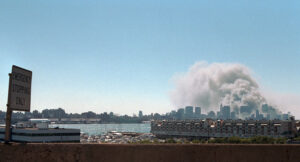
“Smoke rises from the site of the World Trade Center.” White House Photo Office (George W. Bush Administration), National Archives 5997250, September 11, 2001.
For learning and anniversary resources, please visit Flight 93 National Memorial, the 9/11 Pentagon Memorial, and the National September 11 Memorial and Museum.
What do you remember about September 11, 2001?
“The day that lives in infamy” for my generation